About Us – Why Our Astrology is Different
A Research-Based Approach to Astrology
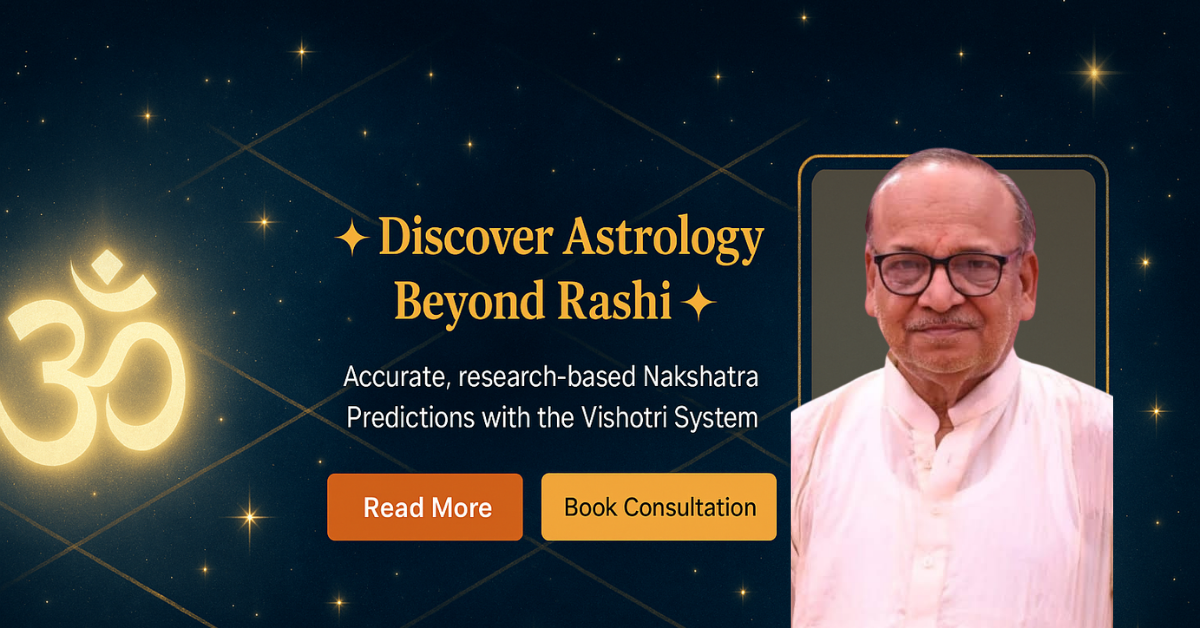
Astrologer Anjani Kumar Sinha has been studying astrology since 1970. Through decades of research, he discovered major gaps in traditional Rashi-based astrology and developed a more accurate, Nakshatra-based system called Vishotri.
Unlike others who give general predictions, our approach ensures sahi samadhan (true solutions) and satik bhavishyavani (precise predictions) tailored to every individual.
1. Nakshatra-Based Predictions
Traditional astrologers focus only on Rashi (zodiac signs). For example, if someone is born in Leo (Simha Lagna), they are told their ruling planet is Sun and all predictions are made accordingly.
But in truth, every Rashi/Lagna is divided into different Nakshatras (sub-divisions). Each Nakshatra has its own ruling planet, which changes the entire prediction.
👉 For instance, in Leo:
Magha (ruled by Ketu) → 0°00′–13°20′
Purva Phalguni (ruled by Venus) → 13°20′–26°40′
Uttara Phalguni (ruled by Sun) → 26°40′–30°00′
So, two people both born under “Leo” can actually have very different life paths, depending on whether they are in Magha, Purva Phalguni, or Uttara Phalguni.
⚡ And this is true for all Rashis and all Lagnas, not just Leo. Each sign is divided into Nakshatras, and unless these are considered, predictions remain incomplete.
👉 That’s why our system, which studies Nakshatra-based Lagna and planetary influence, delivers sahi samadhan (true solutions) and satik bhavishyavani (precise predictions).
2. Corrected Mahadasha System
Other astrologers follow fixed planetary years:
Sun – 6 yrs | Moon – 10 yrs | Mars – 7 yrs
Rahu – 18 yrs | Guru – 16 yrs | Saturn – 19 yrs
Mercury – 17 yrs | Ketu – 7 yrs | Venus – 20 yrs
But here’s the flaw: Rahu and Ketu always move together, so their duration must be equal. Why 18 years for Rahu and only 7 for Ketu? Our research corrects this imbalance, making life events more logically aligned.
We do not agree with this fixed system.
Unlike the traditional fixed 120-year cycle, our Vishotri system is based on the movement of the Moon through all 12 houses.
🔹 Each house is divided into 3 compartments (nakshatra padas).
🔹 When the Moon enters a house, the ruling planet of that compartment starts its time period (dasha).
👉 Example:
If the Moon enters Leo Lagna in a person’s chart and the 1st compartment is ruled by Ketu, then the person’s life begins with Ketu Mahadasha. After Ketu, the cycle continues to Shukra (Venus), then Surya (Sun), and so on, covering all 12 houses.
⏳ Duration of each period:
The time span of each planet is not fixed.
It depends on the speed of the Moon in that sign.
If the Moon moves slower, the period lasts longer; if faster, it becomes shorter.
As an ideal average, we consider 3 years per planetary period.
Thus, every individual has a unique life map, determined by the exact Date, Time, and Place of Birth.
3.Realistic Human Life Span
In Vedic astrology, the traditional system assumes a maximum of 120 years.
We follow a Moon-based cycle method:
1 Day = 3 Years
30 Days = 90 Years (average life span)
👉 For example: If someone is born on 5 Feb 1988, then the first 3 years are counted from that date. From 6 Feb 1988, the next 3 years begin, and so on.
This way, predictions become more realistic, precise, and time-accurate.
📌 Note: The above is only an example. For actual results, one must provide their accurate Date, Time, and Place of Birth. Based on these details, we calculate the individual’s unique planetary timeline.
4. Changing Lagna (Ascendant)
Most astrologers assume your Lagna (Ascendant) stays the same for life. But life is not static — people struggle in childhood, grow stronger in youth, and often succeed later. If Lagna never changed, life would remain the same forever, which is not true.
👉 In our system, Lagna progresses naturally with time.
For example, in Leo Lagna it moves as:
Ketu → Venus → Sun
But this principle applies to all Rashis and Lagnas, not just Leo. Every ascendant follows its own natural sequence of change, based on Nakshatra divisions.
This dynamic approach explains why:
Some people face difficulties early in life but later enjoy success.
Others may rise early and then face challenges later.
By considering progressive Lagna, our system reveals the true journey of an individual’s life — something traditional methods cannot explain.
Vishotri – A New Era of Astrology
In 2004, Anjani Kumar Sinha introduced Vishotri, a revolutionary system based on Nakshatra predictions.
This approach provides:
More Accurate Results
Reliable Guidance
Practical Life Solutions
With Vishotri, we bridge the gap between tradition and truth, ensuring every prediction is clear, logical, and trustworthy.